
AI for narrative
AI for narrative
Narrative is often central to engaging learning design. It can help learners understand why content matters, imagine professional contexts, and connect abstract concepts to real situations. Generative AI can be useful for drafting and varying narrative material, particularly in scenario-based learning, case studies, and explanatory storytelling.
When narrative is used well, it supports meaning-making and transfer. When used poorly, it becomes decorative, unrealistic, or distracting. AI can help produce narrative quickly, but the resulting material still needs to be grounded in authentic context, learning purpose, and tone.
Where AI can help
AI can support the creation of:
- case studies
- scenario introductions
- workplace dialogues
- role-play prompts
- reflective story prompts
- narrative transitions between topics
- alternative versions of the same scenario for different audiences
This is especially useful when a designer needs realistic variation or multiple contextual examples.
Good practice
When using AI for narrative:
-
Ground the narrative in a real context
Provide the vocational, cultural, organisational, or learner context so the output is not generic. -
Keep the educational purpose explicit
A narrative should help learners understand, apply, analyse, or reflect — not simply entertain. -
Check realism and tone
AI can produce dialogue or scenarios that feel polished but unnatural. Revise to fit the real-world setting. -
Avoid unnecessary complexity
Narrative should clarify the learning task, not bury it under too much detail. -
Review for bias and assumptions
AI-generated narratives can encode stereotypes, unrealistic roles, or narrow workplace assumptions.
Risks and limitations
Narrative generated by AI may:
- sound plausible but feel inauthentic
- over-dramatise situations
- miss important cultural or workplace nuance
- make assumptions about people, roles, or motivations
- create scenarios that do not meaningfully support the learning outcomes
For this reason, AI narrative should be reviewed and adapted, particularly when it is used in vocational or culturally sensitive contexts.
Example uses
Example 1: Drafting a case study
A designer asks AI to draft a short workplace case study involving a team communication problem. The draft gives the designer a useful structure, but the details are then edited to reflect the actual sector and learner context.
Example 2: Creating reflective prompts
A designer uses AI to generate multiple short reflective prompts based on a scenario, such as:
- What assumptions did the character make?
- What could have been done differently?
- What policy, process, or communication skill is relevant here?
This can speed up the production of reflective learning content without requiring AI to define the educational logic.
Relationship to other design work
Narrative is often most effective when it supports content creation, frames tasks and activities, and prepares learners for assessment. It should work with the intended learning outcomes rather than sitting alongside them as an afterthought.
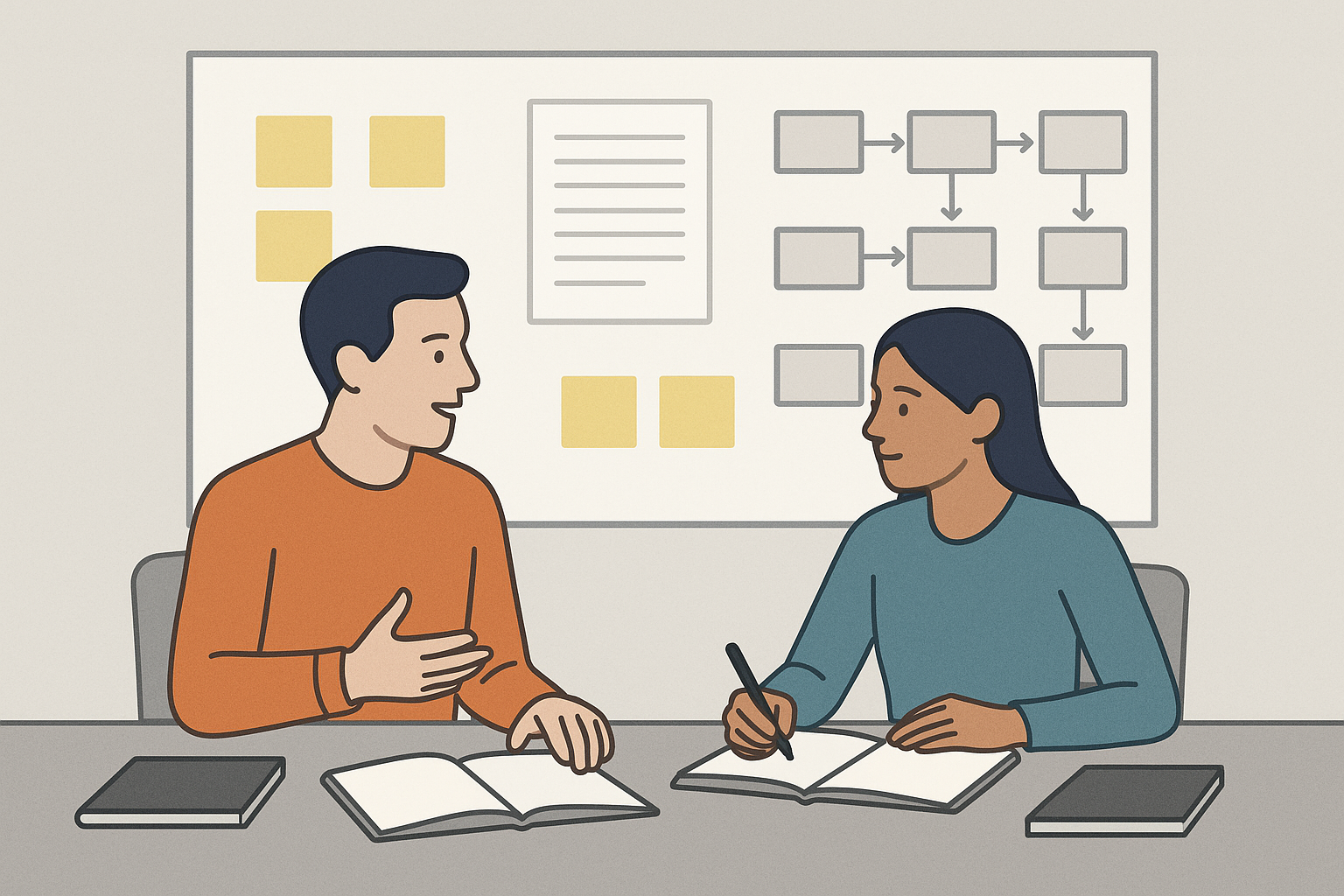
Example: an AI-generated narrative image used to support a workplace case study or scenario-based learning activity.
Practical guidance
AI is helpful for narrative when you need:
- scenario variety
- quick first drafts
- alternate contexts
- dialogue prompts
- narrative framing for content
It is less suitable when the scenario must be highly accurate, culturally nuanced, or directly tied to high-stakes assessment without careful review.
Use AI to accelerate narrative drafting, but shape the final story with clear educational intent and contextual awareness.